THE EQUAL TEMPERED SCALE
As you have seen, to modulate with a keyboard instrument tuned to the just intonation scale produces errors in the frequency (and hence the height) of notes. These errors may be small, but they become much more apparent as you move away from C major. When, at the time of Johann Sebastian Bach (1685-1750), the musicians began to compose using all keys (12 major and 12 minor) it was necessary to find a solution for this problem: a new scale (called
equal tempered scale), obtained by
dividing the octave into 12 equal intervals (called semitones), was thus adopted.
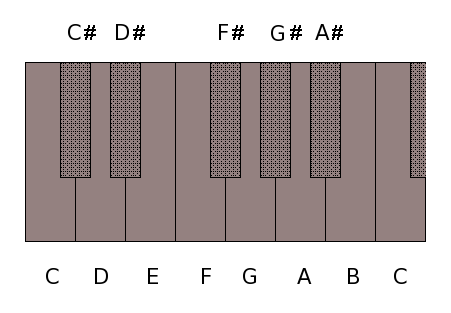
In equal temperament semitones, since they are all the same, have the same frequency ratio x. Denoting by ν(C1), ν(C#1), ... the frequencies of C1, C#1, ... and bearing in mind that the notes of the
chromatic scale 
are C1, C#1, D1, D#1, E1, F1, F#1, G1, G#1, A1, A#1, B1, C2, you have (remember that the frequency of a note is the product of those of a more grave note and the interval that they form, in our case x):
- ν(C1)=1 (units of measurement);
- ν(C#1)=ν(C1)·x=1·x=x;
- ν(D1)=ν(C#1)·x=x·x=x2;
- ν(D#1)=ν(D1)·x=x2·x=x3;
- ν(E1)=ν(RE#)·x=x3·x=x4;
- ν(F1)=ν(E1)·x=x4·x=x5;
- ν(F#1)=ν(F1)·x=x5·x=x6;
- ν(G1)=ν(F#1)·x=x6·x=x7;
- ν(G#1)=ν(G1)·x=x7·x=x8;
- ν(A1)=ν(G#1)·x=x8·x=x9;
- ν(A#1)=ν(A1)·x=x9·x=x10;
- ν(B1)=ν(A#1)·x=x10·x=x11;
- ν(C2)=ν(B1)·x=x11·x=x12.
Since C2, that is the second harmonic, has a frequency of 2, x
12=2 (in fact ν(C2)=x
12 and ν(C2)=2). Ultimately
x is the number that, raised to the twelfth power, gives 2, ie, x =

1.059463.
Note that in the equal tempered scale the frequency that expresses a semitone interval is an irrational number, ie you can not in any way write it as a fraction. In addition, the frequencies of E1 and G1 are, respectively, ν(E1)=x
4=
 4
41.259921 and ν(G1)=x
7=
71.498307: values other than 5/4=1.25 and 3/2=1.5, that you derived from the harmonic series. Enough to make the equal tempered scale an “artificial” scale, that is, less based on physical phenomena. But not too much, so our ear recognises these sounds as almost equal to those of the just intonation scale: the two scales differ little from each other, and often a not particularly sensitive ear does not perceive the difference. In fact, as you can see from the table below, the errors made by using the equal tempered scale instead of the just intonation scale are always lower than 1%.

| COMPARISON OF JUST INTONATION SCALE AND EQUAL TEMPERED SCALE |
As an example you can hear the difference between the melody of Frère Jacques performed using the
 just intonation scale
 (size of musical example: 438 K) and the
equal tempered scale (size of musical example: 438 K).
Note that the just intonation scale, that is based on an acoustic phenomenon (the harmonic series) is, as its name indicates, the most immediate to our ear: then a violinist or a solo singer will also today use this scale. You must not think at the just intonation scale as a thing of the past, now completely fallen into disuse. But if they are accompanied by a keyboard instrument they will use the equal tempered scale.
Finally, observe that, starting from C1 and ascending by n equal intervals characterized by the frequency x you obtain x
n: in particular, ascending by twelve fifths you have:
- (3/2)12 with the just intonation scale;
- [()7]12=27 with the equal tempered scale.
2 is the frequency of C2 (upper octave), and 2
7 is obtained by ascending by 7 octaves: therefore with the equal tempered scale it is completely indifferent to ascend 12 fifths or 7 octaves. Ascending fifth by fifth you will reach to a note with the same name of the initial one.
None of this happens with the just intonation scale: no integer power of 3/2 can also be an integer power of 2. So, if you try to tune a piano by fifths (after the octaves they are the easier intervals than you can get from the harmonic series) you will be brought to use the fifth of the just intonation scale (3/2), that is most immediate to ear. You will first tune all the C, then all the G, after all the D, and so on. But you will be in trouble with the twelfth fifth, that will be out of tune. The skill of a tuner is a little “out of tune” (neither too much nor too little) all the fifths. Because of the difficulty of the operation the last is sometimes called “fifth of the Devil”.