THE PROBLEM OF MODULATION
To
modulate 
from a
major mode to another means to reproduce the same intervals (and therefore the same ratios of frequencies) from a note different from C. Keep in mind that, since ν(C1)=1, the frequency ν
0 of a note of the just intonation scale is the ratio of ν
0 and ν(C1) (divide by 1 is how to do nothing). To obtain the notes of a major scale simply multiply the frequencies of the notes of the just intonation scale by the one of the new
tonic (remember again that, given two notes, the frequency of the most acute is the product of the one of the most grave and the characteristic ratio of frequencies of the interval).
In the figure below you can see the frequencies of the notes of the just intonation scale of:
- C: from C1 to C2 see tabella ; for D2, E2 and F2 simply multiply by 2 the frequencies of the notes an octave lower;
- D: multiply by 9/8 (the frequency of D1) the numbers 1, 9/8, 5/4, 4/3, 3/2, 5/3, 15/8, 2, expressing the frequencies of the notes of the just intonation scale of C;
- E of C: as above, but multiply by 5/4 (the frequency of E1 of the C scale) rather than 9/8;
- E of D: multiply by 81/64 (the frequency of E1 of the D scale).
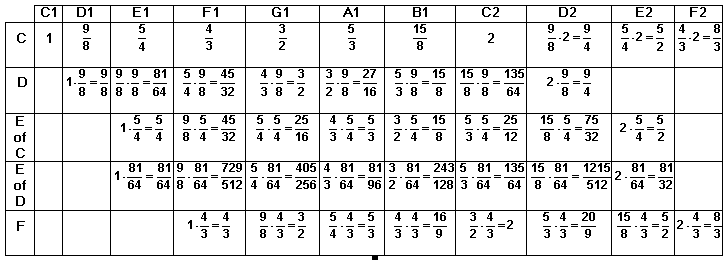
As you can see D2, that in C and D major is 9/4=2.25, assumes instead respectively the values 75/32=2.34375, 1215/512=2.373046875 and 20/9=2.222... in E (of C), E (of D) and F. Also with regard to the other notes only in some cases the frequencies are the same. Imagine how many different frequencies can be achieved, even within a single
octave , keeping in mind that the scales of the figure are just a few examples of many possibilities.
No problem with a violin: just move a finger of the left hand to change, even slightly, the frequency. But how many keys would need a piano? So many to make it virtually impossible to play it. On the other hand 2.25 and 2.222... are not very different from each other, as well as 2.373046875 and 2.34375; on the contrary, 2.25 and 2.34375 are more distant. Because any person, even if not very educated musically, can feel the difference between two notes that have frequency 2.25 and 2.34375, to modulate the only white keys are not enough: you also need the black ones. For example, C# (or D
b) between C and D. However, even as
a keyboard instrument tuned according to the just intonation scale can not prevent from making mistakes modulating from C to another major scale; normally these errors are small, but they tend to grow as the number of sharps (#) or flats (
b) increases.