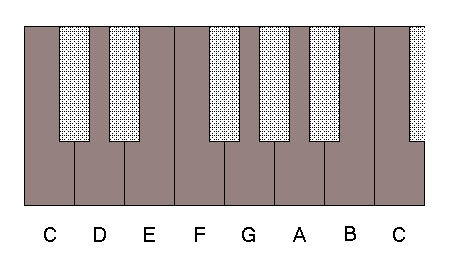
A diatonic scale is composed by the repetition (theorically infinite times; practically within the boundary determined by instrument range) of the sequence made by two tones, one semitone, three tones and one semitone. In this was the scale notes are determined (for example the white keys of the piano), but not a starting point, neither a hierarchy between them.
If instead you choose C as initial note, it achieve a higher significance than the others and it is called tonic or first degree. The C major scale is a diatonic scale composed by the white keys of the piano, which tonic is C. More in detail it is composed by
C (first degree or
tonic),
D (second degree),
E (third degree),
F (fourth degree or
subdominant),
G (fifth degree or
dominant),
A (sixth degree),
B (seventh degree or
leading-note),
C (eighth degree).
Without entering in depth, the most important notes are tonic, dominant and subdominant: in fact the
F, G, C  chords
give a full sense of the C major key.
You can notice that the semitone intervals are located between the third and fourth notes and between the seventh and eighth notes.