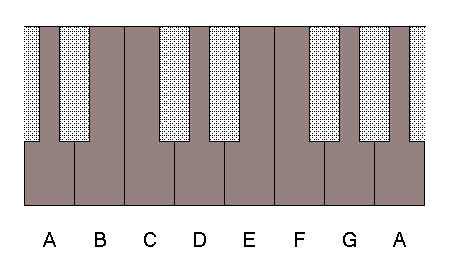
If in a diatonic scale formed by the white keys of the piano you take A as tonic, you obtain the
natural A minor 
scale. The notes that compose it are
A (first degree or
tonic),
B (second degree),
C (third degree),
D (fourth degree or
subdominant),
E (fifth degree or
dominant),
F (sixth degree),
G (seventh degree),
A (eighth degree). A melody in A minor is normally more sad, less bright than a C major one.
The semitone intervals are located between the third and fourth and between the fifth and sixth grade. Unlike the major mode, the semitone interval is missing between the two more higher notes of the scale; for this reason, the seventh degree, in this case, can not be called leading-note.
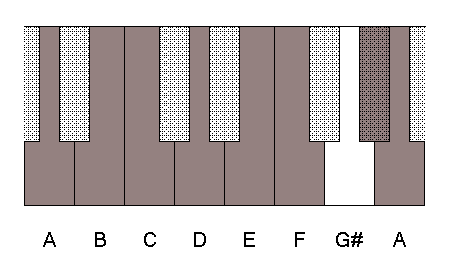
To obtain, as in the major scale, a semitone interval between seventh and eighth grade on the A minor scale and so a greater sense of closure you can raise G by a semitone, replacing it with the G#. The
harmonic A minor scale consists of the notes
A,
B,
C,
D,
E,
F,
G#,
A.
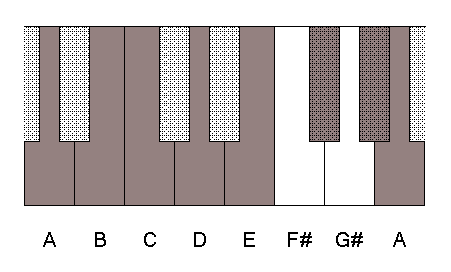
The interval between the sixth and seventh degree of the harmonic minor scale is formed by three semitones. It is quite characteristic and gives a particular color to the pieces in which it is; however, if you prefer, you can raise a semitone, in addition to G, also F. The
melodic A minor scale scale, rising in the acute, consists of
A,
B,
C,
D,
E,
F#,
G#,
A. In descending scale, instead, the notes are as in the natural scale (
A,
G,
F,
E,
D,
C,
B,
A).