OTHER EQUAL TEMPERAMENTS
In the pages on harmony you have dealt with musical scales, that is, how you can organize notes that are somehow already been fixed; in these on acoustics you have tried to understand how (with which frequencies) assign them. In any case, so far you have always read of scales that have had some historical significance. In this page you will wonder why the equal tempered scale divides the octave into exactly 12 parts, and what theoretical alternatives may be possible. As the music might have been (but was not).
Keep in mind that, in the classical tempered scale (division of the octave into 12 semitones), the semitone has frequency

because of the number of semitones. The
radicand 
is the frequency of the octave, and then it does not change if you divide it, for example, into 11 parts instead of 1. What changes is the
index of the root: dividing C1-C2 into n intervals the smallest of them has frequency

.
In the following table the values of n (from 1 up to 24) are indicated in the left column, and to the right the frequencies of the various notes(that, of course, are n+1). The frequencies are shown respectively in red and green if approximate E1 (5/4) and F1 (3/2) of the just intonation scale with an error less than 1%. As you can easily verify, among the considered cases
only a division of the octave into 12, 19 or 24 parts allows you to obtain a chord quite similar to that of C major of the just intonation scale (C1-E1-G1), in the sense that the error committed in both cases is less than 1%.
A chord obtained, remember, just from the physical phenomenon of harmonic series, and for this recognized as pleasing by the ear. Of course, nothing is stopping (or would be stopping) you to use less immediate scale: the temperament with 12 semitones was not adopted because could not happen otherwise, but because the history of western music has followed (at least until the begin of 1900), one of the simplest ways.

| NUMBER OF INTERVALS IN WHICH THE OCTAVE IS DIVIDED (LEFT COLUMN) AND FREQUENCIES OF THE NOTES (RIGHT). RED AND GREEN COLOURS INDICATE THOSE THAT APPROXIMATE RESPECTIVELY E AND G OF JUST INTONATION SCALE WITH A LOWER THAN 1% ERROR |
You would have obtained an equally pleasant effect not only dividing the octave into 24 parts (it is enough to divide each semitone into two equal quarter-tones, since 24 is the double of 12), but also into 19 parts. Here’s how the keyboard of a piano that uses this scale could be: two black keys between two whites, except for E-F and B-C, where there is only one black key. In other words, calling tone the interval, for example, between C1 and D1 (but the term has a different meaning than the classical temperament), each tone is divided into three equal parts; also between E and F and between B and C there is an interval of two thirds of tone. The chromatic scale becomes C, C#, Db, D, D#, Eb, E, E#, F, F#, Gb, G, G#, Ab, A, A#, Bb, B, B#, C. As you can see, I called C# and Db the notes a third of tone respectively higher than C and lower than D: unlike what happens dividing the octave into 12 parts, they are not the same note.
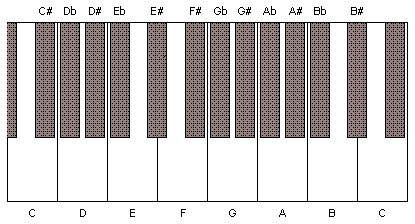
| SO COULD BE THE KEYBOARD OF A PIANO IF THE OCTAVE WERE DIVIDED INTO 19 EQUAL INTERVALS |
Limiting yourself to the notes corresponding to the white keys of this hypothetical piano, you can see in the table below that there are no big difference with the classical tempered scale.

| FREQUENCIES WITH SEVERAL TUNING AND ERRORS WITH RESPECT TO JUST INTONATION SCALE AND CLASSICAL TEMPERED SCALE |
Finally, you can hear a
melody (314 K) 
and its
variation (314 K) based, respectively, on the division into 12 and 19 intervals. Also in this case the effect is not so unfamiliar as you might expect.
Ultimately
and tempered scale with 19 equal intervals between two consecutive C do not seem particularly strange because your ear recognizes the C major chord, derived from the harmonic series, that, though not exact, do not break away much from it.
| Download the scores of musical examples |
detached (MUS and pdf in zip file - 209 K) |
complete score (pdf - 206 K) |