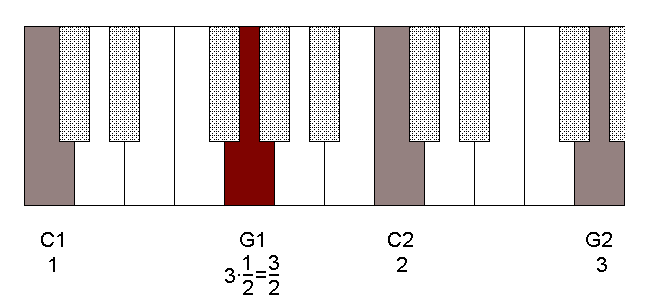
The first two notes of the harmonic series, that have frequency 1 and 2 (from now on you will take as a unit of measure the one of the fundamental note C1), are so similar to give them the same name: C. The interval resulting from their overlap is perceived only as a reinforcement of the melody and not as polyphony, even if the frequencies, and thus the pitches of the notes, are not exactly the same. For example a woman, singing with a man, usually emit sounds of double frequency, without the listener has the impression of listening to a choir of many voices. In fact, the wave form of C1 and C2 is so similar that the ear perceives them as almost identical.
An interval formed by two notes, when the frequency of the second is twice that of the first, is called
octave
; it is the smallest interval between two different notes that have the same name. If the frequency of a note is ν, the note an octave above has frequency ν’=2ν. Conversely ν=ν’/2; then starting from ν’ an octave below you get ν’/2. In other words
you can ascend or descend by an octave, respectively doubling or halving the frequency of the starting note. For example, given that the frequency of the third harmonic (G2) is 3, that of the note an octave below (G1) is half (3/2).
The notes within the octave C1-C2 have frequency between 1 and 2; the other can be brought within this range simply by ascending or descending by an octave, ie multiplying or dividing by 2 their frequency. In particular, while the frequency of the third harmonic (G2) is greater than 2 (3), that of G1 is between 1 and 2 (3/2=1.5). 3/2 (G1) is the product of the base frequency 1 (C1) and 3/2, and 1 (C1) is the quotient of the base frequency 3/2 (G1) and 3/2. In the first case (C1-G1) you ascend, whereas in the second (G1-C1) descend by a
fifth (to be precise, a perfect fifth) so
you can ascend or descend by a fifth respectively multiplying or dividing the frequency of the base note by 3/2. If, for example, a note has frequency 9/8, the one a fifth above has a frequency (9/8)·(3/2)=27/16.