EXAMPLES OF NON-DIATONIC SCALES
MINOR SCALE WITH ALTERED FOURTH DEGREE
| A MINOR SCALE WITH ALTERED FOURTH DEGREE |
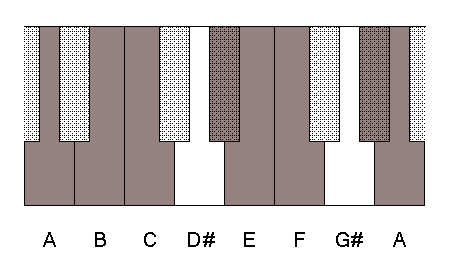
The scale of A
lydian 
differs from the key of A major for the presence of D# instead of D. If, in the harmonic A minor scale, you replace D with D#, you obtain a non-diatonic scale. In fact, there are two intervals, C-D# and F-G#, formed by three semitones (note that also the ascending harmonic and melodic minor scales do not have the exact sequence of tones and semitones of a diatonic scale). These intervals are quite characteristic, and give to the scale an “Arabic” aspect.
“Romance in A minor” 
for piano uses
this scale (Excluding the central part, that is in
lydian mode).
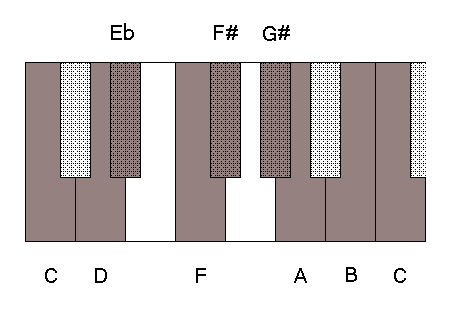
Alternating, starting from C, a tone and a semitone you obtain a
scale of eight notes (one more than diatonic scales) in addition, as usual, to the repetition of the first: exactly
C,
D,
Eb,
F,
F#,
G#,
A,
B,
C. The same succession of intervals, starting from Eb, F# or A, returns the same notes: in fact the first two intervals (tone and semitone), repeated four consecutive times, form the entire scale, that, for this reason, has an indeterminate character: as if it never would end.
This scale is used in a fragment of
Time of love (measures 48-51).
PENTATONIC SCALE
The
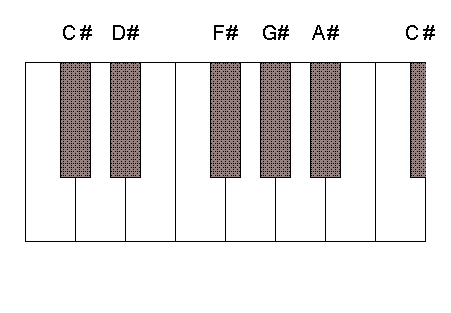
pentatonic scale consists of only five notes, the black keys of the piano:
C#,
D#,
F#,
G#,
A#,
C#. The intervals between consecutive notes are a tone, a tone and half, two tones and a tone and half.
Note the absence of a semitone interval.
WHOLE TONE SCALE
The
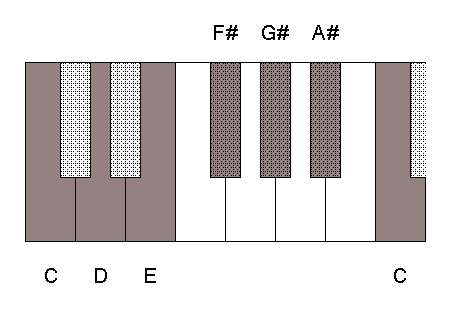
whole tone scale consists of six tone intervals:
C,
D,
E,
F#,
G#,
A#,
C. The structure of the scale gives, as for the tone-semitone scale, a character of constant tension, as if the final note was lacked.